


































Kari
Redefining Commuting for the Everyday Nigerian
Transportation · Mobility · Lifestyle

Project Summary
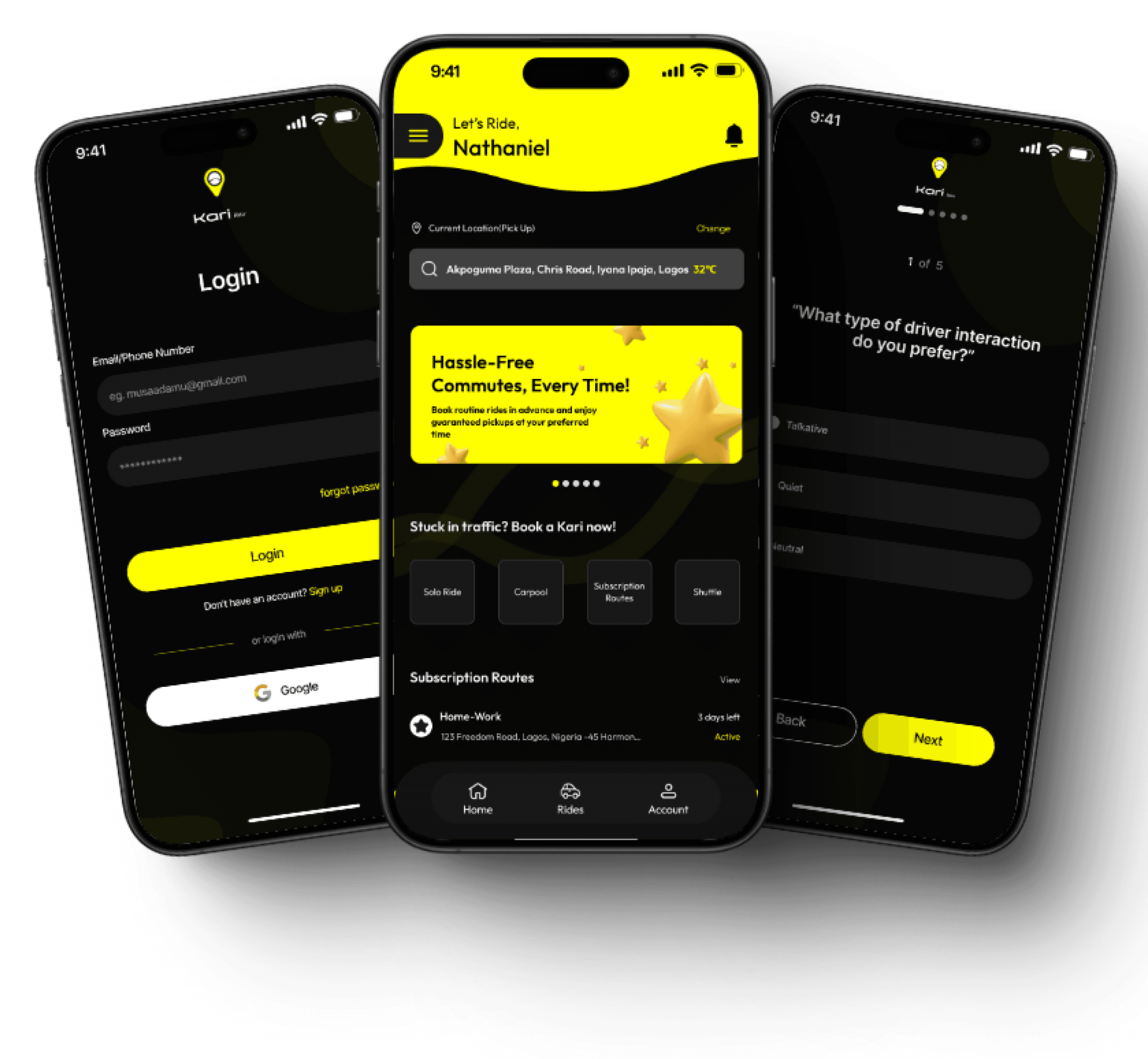
Kari is a location-aware commuting app tailored for Nigeria's unique urban and socio-economic dynamics. It allows users to book rides, share daily commutes, and access affordable transport options in real-time. The platform prioritizes reliability, accessibility, and simplicity—helping users get from point A to B with peace of mind.
My Role
As the sole Product Designer on the project, I:
Led user research and interviews
Defined user flows and journey maps
Created wireframes and interactive prototypes
Designed the visual interface for the mobile app
Developed the design system and documented handoffs for developers
Provided continuous feedback throughout development sprints
The Team
Product Manager: Chineme Dimpka
Lead Product Designer: Christopher Akpoguma
Product Designer: Olulanke Oluwatofunmi
Fullstack Developer: Chineme Dimpka
QA Tester: Ayuba Ebenezer
45%
Reduced average booking time
2 minutes
Total of Optimized onboarding
90%
feature access offline during trip
70%
User comfort with playlist and driver profile option
Where It All Began: The Traffic in Our Lives
In cities like Lagos, Port Harcourt, and Abuja, daily commuting is a stress test. Between unreliable transportation and rising costs, getting around is both chaotic and unpredictable. Kari was born out of the need to create a safe, smart, and socially aware ride-booking experience that reflects local realities, not just copy-paste global ride-share models.
People didn’t just want a ride, they wanted the right kind of ride
Riders expressed a desire to choose their driver based on personality types, whether they preferred someone chatty (Conversationalist), quiet (Reserved), or neutral. It wasn’t just about movement, it was about the vibe of the ride. This small but thoughtful feature gave users autonomy and emotional comfort, especially during long or stressful commutes.
We also introduced a personal playlist sync feature. Commuters could link their music preferences so drivers (who opt-in) could match the ride’s soundtrack to the user’s mood—whether they needed Afrobeat energy, gospel calm, or silent stillness.
Kari wasn’t just solving a transit problem. It was creating a cultural shift in how people experience getting around.





Roadblocks on the Runway
Designing Kari wasn’t a freeform creative exercise—it was a thoughtful process shaped by multiple real-world constraints. One of the biggest challenges was ensuring the app remained performant and visually clear on low-end Android devices, which make up a significant portion of the market in Nigeria. This meant optimizing every component, minimizing animations, reducing the number of assets loaded, and simplifying layouts without sacrificing clarity or delight.
We also had to consider inconsistent internet connectivity. Many users would move in and out of stable networks during a ride, so the experience needed to feel stable and informative even when offline or partially connected. This led to critical UX decisions, like caching ride details and building visual placeholders that made network disruptions feel less abrupt.
From a UI standpoint, there was a need to strike a balance between minimal complexity and visual engagement. The design had to be intuitive for users unfamiliar with digital services but still feel fresh and modern. This eliminated the possibility of using overly complex navigation patterns, dense text blocks, or unfamiliar iconography. Every interaction had to be natural, obvious, and guide the user clearly from point A to B.
Lastly, we had to design with scalability in mind. While the MVP focused on ride booking, we knew future iterations would include features like driver rewards, group rides, and hub systems. We architected the UI framework to accommodate these changes with minimal disruption to the user experience or design system.
Understanding Our Users
To build an experience rooted in real needs, we conducted user interviews with people across Nigeria’s major cities; Lagos, Port Harcourt, and Abuja. These interviews informed 3 key personas that became central to our design decisions.



User Journeys
To build an experience rooted in real needs, we conducted user interviews with people across Nigeria’s major cities; Lagos, Port Harcourt, and Abuja. These interviews informed 3 key personas that became central to our design decisions.